

Have you ever thought about why some online shops are constantly buzzing while others disappear into digital nirvana? The answer is often hidden in two letters: UX.
UX, or "user experience", refers to the experience that users have with a product or service.
Your Online shop is like a physical shop
Imagine walking into a shop and immediately finding your way around. Everything is intuitive, the atmosphere is welcoming and you get exactly what you're looking for without having to ask for help. That feels good, doesn't it? That's UX in E-Commerce. It's all about providing your customers with a smooth and pleasant experience.
"Good UX design makes a bad online shop good and an already good online shop excellent."
More than just beautiful design
But don't be fooled by shiny surfaces! Good UX Design goes deeper. It's about understanding and empathy. It's about listening to your customers and giving them what they really want and need.
Here are the basic principles of UX design and why they are so important:
- User-centredness: The design should always be created from the user's perspective. What do they need? What do they want? A design that answers these questions is more effective and more attractive.
- Simplicity and clarity: Users should not have to guess how something works. An intuitive design makes it easy for them to find their way around.
- Consistency: Similar elements should always look and function in the same way. This makes it easier for users to understand and navigate.
- Feedback: Users should always know what is happening. This can be achieved through messages, animations or other notifications.
- Error avoidance: Good design helps users to avoid errors and provides clear solutions when errors occur.
- Flexibility and efficiency: Experienced users should be able to perform tasks faster, while newcomers are still supported.
- Aesthetics: An appealing design can increase confidence in a product or service and improve the overall experience.
A good UX design makes customers happier, can increase loyalty, boost conversion rates and ultimately increase sales.
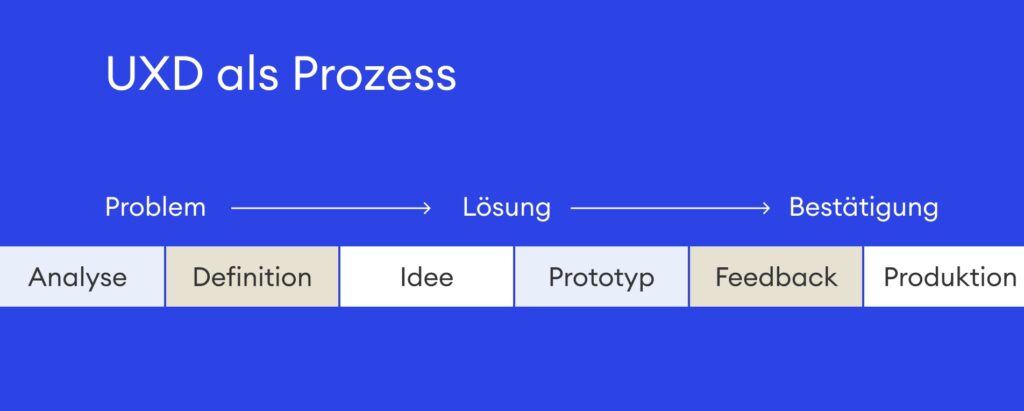
UX development in process - how we turn your brand into an experience
In today's digital landscape, it is crucial that websites are not only functional, but also appealing and user-friendly. At Kombinat, we have a systematic UX design process that guarantees exactly this. Here is a brief overview of our approach:
- Analysis: It all starts with understanding your customers' needs. Through contextual interviews and close observation of how users interact with your website, we identify the key areas for improvement.
- Definition: Based on the insights gained, we define clear objectives and requirements for the project.
- Idea: This is where creativity and innovation come into play. We develop unique concepts that both reflect your brand identity and are tailored to the needs of your customers.
- Prototype: Using prototypes - from simple sketches to fully developed designs - we test ideas and functions before they are fully realised.
- Feedback: We use remote user testing to systematically gather user feedback in order to refine and improve the prototypes.
- Production: Once all aspects have been tested and optimised, the final production phase begins.
Our approach can also be iterative and aims to avoid barriers for your customers and give you a competitive advantage while avoiding unnecessary bad investments. Our professional Design systems ensure that every element of your website is functional, appealing and true to your brand.
Your investment pays off
Perhaps you think this is only for the "grown-ups" out there? Far from it! Medium-sized companies like yours can benefit enormously from outstanding UX design. It's an investment that pays off in loyal customers and rising sales figures.
"That all sounds great, but where do I start?", have a look at Kombinat Berlin over. There are many exciting insights and expertise in the field of e-commerce that will certainly help you. We turn your brand into an experience.
What does your business model look like?
B2B, D2C, B2C or a hybrid form? Or do different business areas need to be linked together?
We are always curious and will help you with our diverse experience
Tell us more

 German
  English